The Organisation Capability Series™: Journey – Continuous strengthening - From Journey™ to Organisational Capability Framework™
Annick Rogiers · Founder, Sustainable Wellbeing Solutions — I help HR, HSE and prevention leaders prove how they manage psychosocial risk, not just describe it.
Why did the Organisational Capability Journey™ become a Framework?
Because integration isn't the destination. It is where the harder question begins: what keeps capability strengthening after it is embedded?
When I first started writing about psychological safety, psychosocial risk management and organisational capability, I had no intention of developing a framework. My objective was simpler: I wanted to understand why so many organisations invest considerable time, resources and commitment in creating healthier workplaces, and still struggle to achieve sustainable change.
Across many organisations, I observed thoughtful initiatives being introduced: leadership development, wellbeing programmes, psychosocial risk management, psychological safety, governance improvements. Each had value in its own right — yet they were developed, implemented and evaluated separately. Organisations invested significant effort without creating the coherent capability needed to sustain long-term change.
Expectations around psychosocial risk management, psychological safety, ESG and standards such as ISO 45003 are growing. They require more than individual initiatives. They require an organisational approach in which leadership, governance, work design and decision-making reinforce one another rather than operate independently.
What question started the Journey?
Not "how do we introduce another initiative?" — but "how do organisations develop capability that continues to strengthen over time?"
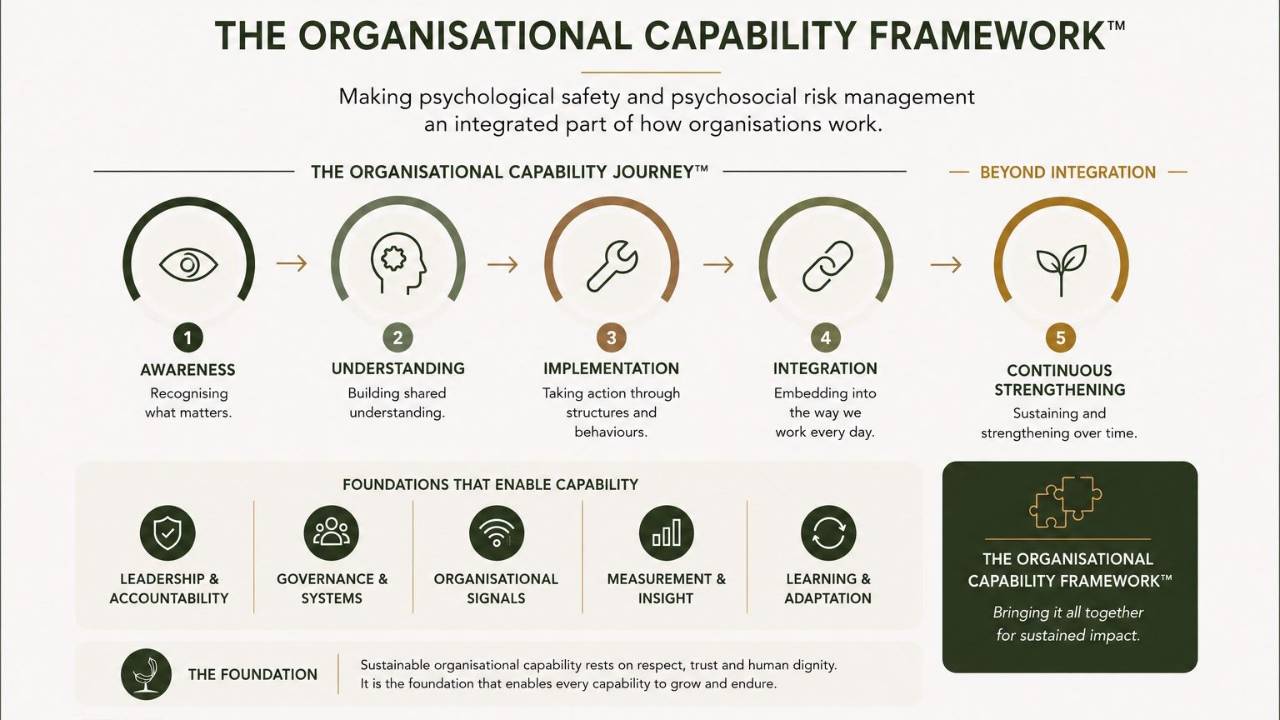
That question became the starting point for The Organisational Capability Journey™, developed through Executive Insight 01. The Journey introduced five progressive stages through which organisations build capability:
- Awareness — creating a shared language around psychosocial risks
- Understanding — recognising how people experience pressure and adversity
- Implementation — translating insight into operational work processes
- Integration — embedding it into governance, ISO 45003 and ESG
- Continuous strengthening — It holds when pressure arrives, not only when conditions are calm.
For many organisations, integration appears to be the destination — the point at which psychological safety, psychosocial risk management and organisational learning become part of everyday practice.
Why wasn't integration the end of the work?
Because integration explains how capability becomes part of an organisation. It doesn't explain why some organisations keep strengthening that capability while others gradually lose momentum.
The conversations that followed the Journey suggested something more nuanced, and introduced a new question: what happens after integration?
The pattern is consistent: capability is not a self-sustaining asset. Under sustained pressure, routines can progressively weaken — often staying latent until a shock exposes the fragility. Maturity is not a stable endpoint. It is a condition that needs supportive governance, learning and renewal to hold.
The Organisational Capability Framework™ emerged from that question: which capabilities enable organisations not only to integrate psychological safety and psychosocial risk management, but to sustain, strengthen and adapt them over time?
What is the difference between the Journey and the Framework?
The Journey describes the stages. The Framework describes what sustains them.
Rather than providing an immediate answer, I recognised this question deserved careful exploration. Over recent months, each article in The Organisational Capability Series™ has examined one aspect of this conversation — organisational signals, leadership accountability, learning and adaptation — gradually revealing the capabilities that appear to influence whether healthy workplaces continue evolving.
To make this progression easier to understand, I developed a roadmap showing where the Journey began, how the articles connect, and how these conversations are contributing to the Framework.
The Framework works across four levels — Quick Start, Functional, Business and Corporate.
The Framework is the natural continuation of the Journey, not its replacement.
What comes next?
The Series continues — not by presenting isolated solutions, but by examining the capabilities that sustain healthy workplaces over time.
Because perhaps organisational capability is not something organisations simply build. Perhaps it is something they continuously strengthen.
The next four articles examine each stage in turn — Awareness, Understanding, Implementation and Integration — and what each one asks of an organisation.
Where this fits in my work?
If your organisation recognises this and wants to act on it, there are two ways I work with organisations:
Consultancy— assess priorities, clarify responsibilities, and integrate psychosocial risk into leadership, work practices and governance.
Turn policy into proof →
The Academy — one structured online pathway that builds capability internally.
Explore the Academy →
Download for free 'the organisational capability journey'
