Organisational Capability — Integration within The Organisational Capability Framework™
Why does psychological safety feel strong in one team and absent in another?
Because the organisation manages psychological safety, psychosocial risk, leadership and governance as separate conversations — while employees experience it as one.
Over the past decade, organisations have made significant progress in recognising the importance of psychological safety, mental health and psychosocial risk management. Topics once rarely discussed have become part of leadership conversations, wellbeing strategies and organisational agendas.
Yet many organisations continue to encounter a familiar challenge. Employees describe very different experiences depending on the team they work in. Some leaders create environments where people feel comfortable speaking up. Others struggle to translate organisational intentions into everyday practice.
Why does sustainable change remain so difficult, when organisations are investing more than ever before?
Why doesn't investment alone create consistency?
Because the answer rarely lies in a lack of commitment — it lies in how the efforts are organised.
Psychological safety, psychosocial risk management, leadership development, wellbeing and governance are frequently managed as separate conversations. HR focuses on wellbeing, HSE on psychosocial hazards, leadership teams on culture, governance functions on accountability and reporting.
Each perspective is valuable. The difficulty is that employees do not experience them separately. They experience the organisation as a whole.
When an employee returns to work after a traumatic event, they do not distinguish between HR, leadership, operational processes or risk management. People experience the connections between organisational systems — or they experience the gaps.
What does integration actually mean?
Embedding psychological safety and psychosocial risk management into how the organisation leads, decides, manages risk and evaluates success.
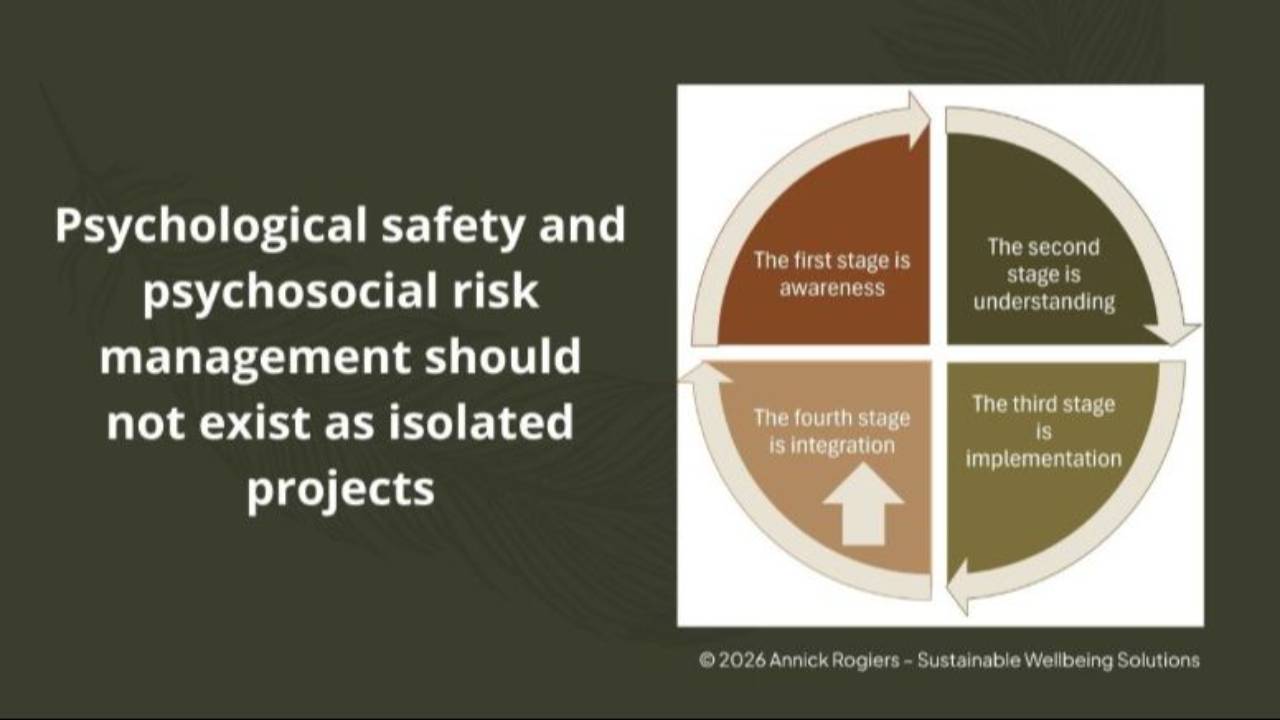
Integration builds on awareness, understanding and implementation. It is the stage where psychological safety and psychosocial risk management stop being individual initiatives and begin to influence the way an organisation operates as a whole.
This shift is becoming increasingly important. Internationally, standards such as ISO 45003 encourage organisations to adopt a more systematic approach to psychological health and safety. Governance expectations are evolving, and ESG discussions increasingly recognise the relationship between people, culture, risk and long-term sustainability.
In this context, psychological safety is no longer simply a wellbeing issue. It is becoming an organisational capability.
What distinguishes the organisations making real progress?
Not the highest number of initiatives — the greatest coherence between them.
The organisations making the greatest progress have found ways to connect leadership, operational practice, risk management and governance into a coherent approach.
Away from isolated programmes. Away from fragmented ownership. Towards integration.
Because psychological safety becomes sustainable when it is embedded not only in what organisations say, but also in how they lead, make decisions, manage risk and evaluate success.
If psychological safety disappeared from your wellbeing programme tomorrow, where else in your organisation would evidence of it still be visible?