Awareness: Why Awareness Is More Than Awareness
Annick Rogiers Founder, Sustainable Wellbeing Solutions
Organisational Capability — Awareness within The Organisational Capability Framework™
What does awareness actually require in psychological safety and psychosocial risk?
Not information. A shared language.
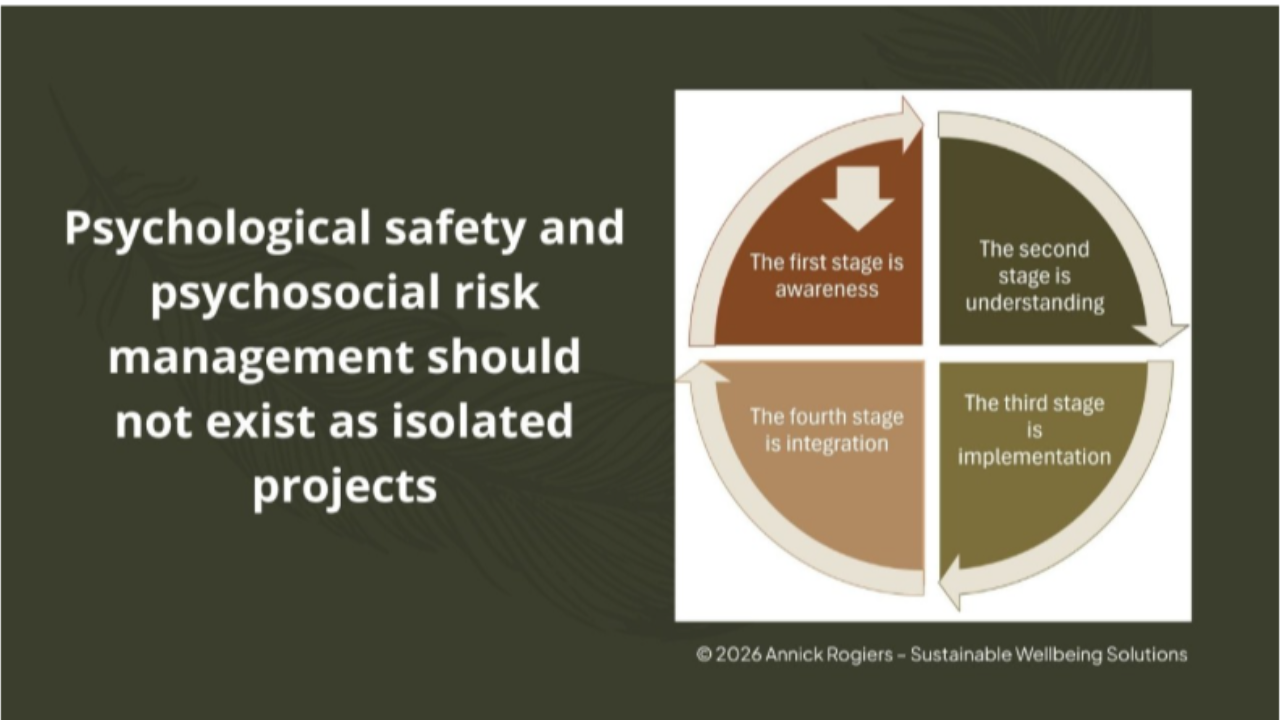
In my previous article, I introduced four stages organisations move through when embedding psychological safety and psychosocial risk management into everyday work: Awareness. Understanding. Implementation. Integration.
The first stage may seem the simplest. Yet in my experience it is often the most underestimated.
Why isn't awareness the same as information?
Because a workshop or a campaign rarely changes how organisations respond.
Many organisations associate awareness with providing information. A workshop. A campaign. A policy update. An awareness week. These have value but awareness alone rarely changes how organisations respond to psychosocial challenges.
For me, awareness begins with something more fundamental. A shared language. A language that helps people recognise psychosocial risks before they escalate. A language that gives managers confidence to have difficult conversations. A language that connects HR, HSE, prevention, leadership and governance, rather than allowing each function to work in isolation.
What happens without a shared language?
Departments use different terminology, employees are uncertain what they can raise, and signals recognised in one part of the organisation stay invisible in another.
-
Different departments use different terminology
-
Employees are uncertain about what they can talk about
-
Managers worry about saying the wrong thing
-
Important signals are recognised by one part of the organisation but remain invisible to another
