Foundation – Learning & Adaptation: What Actually Changes After an Organisation Learns Something?
Annick Rogiers Founder, Sustainable Wellbeing Solutions - Connecting Psychological Safety, Psychosocial Risk and Organisational Practice
What actually changes after an organisation learns something?
The assessment identified the risk. The organisation acted. The evidence now tells you whether something changed. But there is one more question:
What does the organisation do with what it has learned?
Because evidence alone does not strengthen an organisation. An organisation can identify a psychosocial risk, investigate what happened, introduce controls and measure the outcome and still return to exactly the same conditions six or twelve months later.
- The report was completed.
- The action was closed.
- The attention moved elsewhere.
- And gradually, old patterns returned.
Learning happened. Adaptation did not. That distinction matters.
Learning is not the same as knowing
In my previous article on Measurement & Insight, I explored the difference between measuring activity and understanding whether conditions have actually changed.
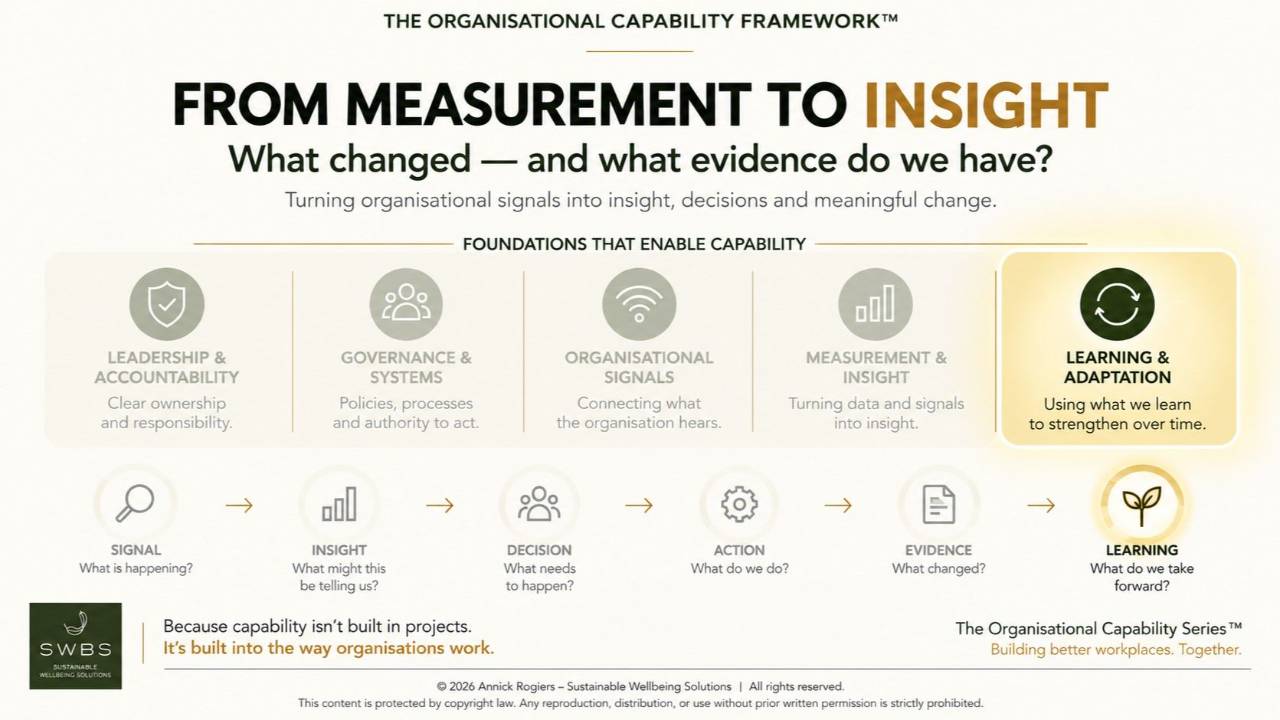
That brought us to: Signal → Insight → Decision → Action → Evidence → Learning
But Learning cannot simply be the final box in a process. If an organisation has learned that sustained workload contributed to psychosocial risk, what happens with that knowledge?
- Does it influence future workforce planning?
- If unclear responsibilities contributed to pressure, are roles redesigned?
- If employees raised concerns too late because they did not believe anything would happen, does the organisation change how managers respond to early signals?
- If a restructuring created unintended psychosocial risks, does that learning influence how the next organisational change is designed?
- If not, the organisation may have learned something about one event without becoming better at managing the next one.
The real question is: where does the learning go?
- Organisations generate learning constantly.
- Risk assessments identify hazards.
- Investigations reveal weaknesses.
- Employee surveys expose patterns.
- Exit interviews tell stories.
- Absence and return-to-work processes provide information.
- Managers encounter pressure in their teams.
- Employees raise concerns.
- Audits identify gaps.
But what happens to all that knowledge?
Too often, it remains where it originated. An HR issue produces an HR response. A safety issue produces an HSE action. A complaint produces an investigation. An absence case produces an individual return-to-work plan. A survey produces another action plan. Each response may be appropriate.
But:
Does what one part of the organisation learns change how the wider organisation works?
That is where Learning & Adaptation becomes an organisational capability.
Closing an action is not the same as closing the loop
Consider excessive workload again. An assessment identifies it as a significant psychosocial risk. The organisation responds by redistributing tasks and adding temporary resources. Measurement shows an improvement. The action is marked complete. But what did the organisation learn? Perhaps the workload problem emerged because staffing decisions were based on headcount rather than actual work demands. Perhaps managers had been raising capacity concerns for months, but those signals never reached the people making resource decisions. Perhaps targets continued to increase while staffing remained unchanged. Perhaps responsibilities were spread across functions, but nobody had authority to intervene. If the organisation only fixes the immediate workload problem, it has responded. If it changes how staffing, targets, escalation or resource decisions are made in the future, it has adapted.
That is a very different outcome.
The purpose of learning is not only to understand what happened. It is to change what happens next.
Where adaptation becomes visible
Learning & Adaptation should eventually become visible in organisational practice. Not only in a lessons-learned document. Not only in a revised policy. And not only in another training programme.
It may become visible in how:
- work is designed and resources are allocated;
- managers recognise and escalate early warning signals;
- HR, HSE, Wellbeing and Operations share information;
- psychosocial risk is considered during organisational change;
- decision rights and accountability are clarified;
- leadership responds when evidence challenges existing priorities;
- controls are reviewed when circumstances change;
- employees see that speaking up can lead to meaningful action.
The question becomes:
Did we correct the problem or did we strengthen the system that allowed the problem to develop?
This is why learning crosses organisational boundaries
Learning & Adaptation cannot sit with one function.
- HR may understand the people impact.
- HSE may understand the risk.
- Operations may understand the work.
- Managers may understand what happens in daily practice.
- Leadership may control resources and priorities.
- Governance may determine accountability and oversight.
- Each may hold part of what the organisation needs to learn.
Organisational learning happens when those perspectives can be connected and translated into changes in how the organisation operates.
This is why the foundations within The Organisational Capability Framework™ cannot function independently.
- Organisational Signals help the organisation hear what is happening.
- Measurement & Insight helps it understand what those signals may mean.
- Leadership & Accountability establishes who owns the response.
- Governance & Systems provides the structures, mandate and authority through which action can happen.
- And Learning & Adaptation asks: What are we going to do differently because of what we now know?
Again, the capability sits in the connections.
The real test comes when pressure returns
There is another dimension to learning that deserves attention. An organisation can change successfully after an assessment or incident. For a while.
- Managers have the conversations.
- New processes are followed.
- Workload is monitored.
- Concerns are escalated.
- Leadership attention remains high.
- Then priorities change.
- A deadline approaches.
- Budgets tighten.
- A new leader arrives.
- The organisation restructures.
- Commercial pressure increases.
- And slowly, familiar behaviours return.
This is why adaptation cannot be judged only immediately after an intervention.
The real test of organisational capability may be what remains when the organisation comes under pressure again.
That takes us beyond implementation towards Continuous Strengthening.
Because capability is not self-sustaining. What has been learned needs to become sufficiently embedded in work processes, leadership expectations, decision-making and governance that it does not disappear as soon as attention moves elsewhere.
From lessons learned to organisational learning
Many organisations already ask: What did we learn?
I would add another question:
Where did that learning change the organisation?
- Did it change a decision?
- A process?
- A role?
- A control?
- A leadership expectation?
- The design of work?
- The way future organisational change is approached?
- The way information reaches decision-makers?
- The authority someone has to intervene?
Because if nothing changes outside the case, project or intervention from which the learning emerged, we should ask whether the organisation has really adapted.
One question to take back
Take one psychosocial risk, investigation, employee concern or intervention your organisation has dealt with during the past twelve months.
Ask:
What does our organisation do differently today because of what we learned?
If the answer is difficult to identify, the learning may still be sitting in a report, an action plan, a team or an individual function.
The next step is not necessarily another initiative.
It may be to ask how that learning becomes part of the way the organisation works.
Because ultimately:
An organisation does not become more capable because it learned something. It becomes more capable because it can adapt because of what it learned.
From insight to adaptation
Learning & Adaptation is one of the five foundations of The Organisational Capability Framework™.
The Framework explores how organisations connect Leadership & Accountability, Governance & Systems, Organisational Signals, Measurement & Insight, and Learning & Adaptation to make psychological safety and psychosocial risk management part of how the organisation actually works.
If your organisation is identifying psychosocial risks and taking action, but finding it difficult to translate what it learns into lasting organisational change, this is where I help organisations identify the capability gaps between insight, action and integration.
