What Should You Measure After a Psychosocial Risk Assessment?
Annick Rogiers Founder, Sustainable Wellbeing Solutions - Connecting Psychological Safety, Psychosocial Risk and Organisational Practice
From assessment to evidence: how organisations can connect psychosocial risk data, accountability and action to understand whether their response is actually working.
A psychosocial risk assessment identifies excessive workload. The organisation responds. An action plan is created. Managers receive additional guidance. Workload is discussed. Support is made available. Perhaps staffing, priorities or ways of working are adjusted. Six months later, someone asks a very reasonable question:
Did it work?
And suddenly, the answer may be much harder than expected. The assessment told us that a risk existed. The action plan documented what the organisation intended to do. But neither necessarily tells us whether the conditions contributing to the risk have actually changed. This is where psychosocial risk management moves into another phase. Not simply:
Did we assess the risk?
Or even:
Did we take action?
But:
What changed and what evidence do we have that it changed?
The assessment is only the beginning
In my previous article, Psychosocial Risk: What Happens After the Assessment?, I explored a fundamental organisational question. When a serious psychosocial risk is identified, who connects the different signals? Who owns the risk? Who has the authority to act when addressing it requires changes to workload, work design, organisational priorities or leadership decisions? Those questions remain important. But they lead to another one. Once the organisation has acted, how does it know whether its response is working? Psychosocial risk management cannot end when an action is marked as completed. Completion tells us that something was done. It does not necessarily tell us that the risk is being better controlled.
The data may already exist
Organisations often collect far more information about psychosocial risk than they realise. HR may hold data on absence, turnover, grievances, exit interviews and return to work. HSE or Prevention may hold risk assessments, incident information, hazard reports and corrective actions. Wellbeing or occupational health may see patterns in requests for support. Operations may hold information about overtime, staffing levels, workload, vacancies, productivity and operational pressure. Employee surveys may provide information about workload, role clarity, trust, leadership or people's willingness to speak up. Workers' compensation or insurance information may reveal another part of the picture. And management may be looking at performance and delivery indicators. The challenge is that these signals are often examined separately. Employees do not experience them separately. They experience one organisation. That changes the measurement question. Instead of asking only:
What data do we have?
We may need to ask:
What becomes visible when we connect what we already know?
From separate data points to organisational insight
Imagine an assessment identifies sustained workload pressure in one part of an organisation. Taken separately, the organisation may see:
-
increasing absence;
-
persistent overtime;
-
difficulties filling vacancies;
-
declining employee survey results;
-
more requests for support;
-
managers struggling to meet targets;
-
concerns being raised about workload;
-
people returning from absence but subsequently leaving.
None of these signals, on its own, necessarily explains what is happening. Nor should a single signal automatically be treated as proof of causality. But when different sources begin pointing in a similar direction, they may justify a deeper organisational question.
Is there a pattern we need to understand?
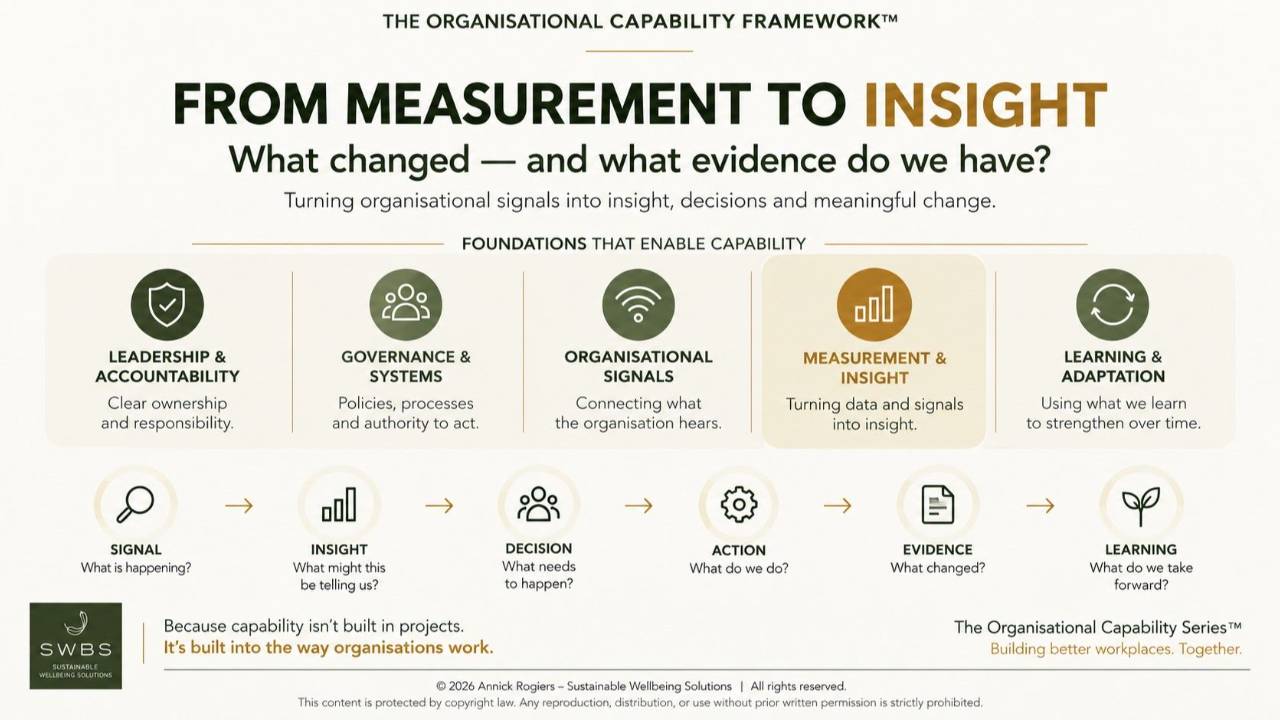
That is different from simply producing a dashboard. It requires the organisation to connect information across functions, examine context, test assumptions and decide whether further action is needed. This is what I mean by Measurement & Insight within The Organisational Capability Framework™. Measurement collects information. Insight helps the organisation understand what that information may be telling it.
Are we measuring activity or change?
This distinction matters. An organisation can measure:
-
how many managers completed training;
-
how many employees used an EAP;
-
whether an assessment was completed;
-
how many actions were entered into a risk register;
-
how many wellbeing initiatives were launched;
-
or how many policies were reviewed.
These measures may be useful. But primarily, they tell us about activity. They do not necessarily tell us whether the conditions associated with the psychosocial risk have changed.
-
If excessive workload was identified, has the workload become more manageable?
-
If role ambiguity was contributing to risk, are responsibilities now clearer?
-
If employees were reluctant to raise concerns, are concerns surfacing earlier — and what happens when they do?
-
If staffing levels contributed to sustained pressure, has that exposure changed?
-
If leadership behaviour formed part of the concern, what changed in accountability, oversight or ways of working?
-
If people were struggling to return after prolonged absence, what does the longer-term return-to-work and retention picture tell us?
The measurement question therefore moves from:
What did we do?
to:
What is different because we did it?
Leading indicators may be closer than we think
This also means organisations may need to look beyond traditional lagging indicators. Waiting for absence, claims, turnover or harm to increase before deciding whether an intervention worked may tell us something only after the problem has progressed. There may already be earlier organisational signals.
-
Are workload concerns being raised sooner?
-
Is overtime reducing?
-
Are vacancies being filled?
-
Are teams operating with sufficient resources?
-
Are managers escalating capacity concerns before they become incidents?
-
Do employees believe raising a concern results in a meaningful response?
-
Are agreed controls actually being implemented in day-to-day work?
This is also where measurement needs context. A rising number of concerns, for example, does not automatically mean the organisation has become less safe. It could indicate deteriorating conditions. But it could also mean people have become more willing to speak up. A number without organisational context can easily lead to the wrong conclusion. The purpose of measurement should therefore not be to produce a reassuring score. It should be to improve the organisation's ability to understand what is happening and decide what needs to happen next.
Measurement cannot stand alone
And here we arrive at an important point. Even excellent measurement cannot reduce psychosocial risk on its own. Suppose the connected evidence shows that workload remains unsustainable.
-
Who receives that information?
-
Who owns the risk?
-
Who decides whether further intervention is necessary?
-
Who has authority to change staffing, resources, targets, priorities or work design?
-
And who checks afterwards whether those decisions actually made a difference?
This is why Measurement & Insight is only one foundation of The Organisational Capability Framework™.
It needs to connect with:
-
Organisational Signals — Can information surface, and can different signals be connected?
-
Measurement & Insight — Can the organisation turn those signals into a reliable picture rather than isolated numbers?
-
Leadership & Accountability — Who owns the response and remains accountable for what happens next?
-
Governance & Systems — Does responsibility come with sufficient mandate and authority to act?
-
Learning & Adaptation — What changes because of what the organisation has learned?
Because the capability does not sit inside one survey, dashboard, department or intervention. Organisational capability sits in the connections.
From assessment to evidence
A mature approach to psychosocial risk therefore needs to be able to follow a chain:
Signal → Insight → Decision → Action → Evidence → Learning
The assessment identifies the risk. Organisational signals help us understand where and how it may be appearing. Measurement helps build a clearer picture. Accountability establishes who needs to respond. Authority enables action. Evidence helps determine whether the action is making a difference. Learning feeds that knowledge back into how the organisation works. And then the cycle continues. That last part matters. The objective is not simply to prove that an intervention succeeded. It is to make the organisation more capable the next time a risk emerges.
One question to take back to your organisation
Take one significant psychosocial risk currently sitting in your risk register.
Then ask:
What evidence would convince us twelve months from now that this risk is being better controlled?
Not:
-
Did we complete the action plan?
-
Did managers attend the training?
-
Did we introduce another programme?
But:
-
What would actually be different?
-
What would employees experience differently?
-
What organisational signals should change?
-
What operational indicators might change?
-
Who would see those changes?
-
And who would decide whether the response was sufficient?
If these questions are difficult to answer, the organisation may not necessarily need more data. It may need a stronger connection between the data it already has, the people who interpret it, the people with authority to act and the mechanisms through which the organisation learns.
Psychosocial risk management becomes much more powerful when organisations can move from identifying risk to demonstrating what changed.
