Are Organisations Ready for Europe’s Growing Focus on Psychosocial Risk?
Annick Rogiers Founder, Sustainable Wellbeing Solutions - Connecting Psychological Safety, Psychosocial Risk and Organisational Practice
The real challenge may not be identifying psychosocial risks, but having the organisational capability to act on what they reveal.
Many organisations are already doing something about workplace wellbeing. They conduct employee surveys. They offer an EAP. They provide mental health support. HR monitors absence. HSE carries out risk assessments. Managers receive training. Policies exist for bullying, harassment and inappropriate behaviour. So perhaps the question is no longer:
Are we doing enough?
Perhaps the better question is:
Can our organisation connect what it already knows and act on it?
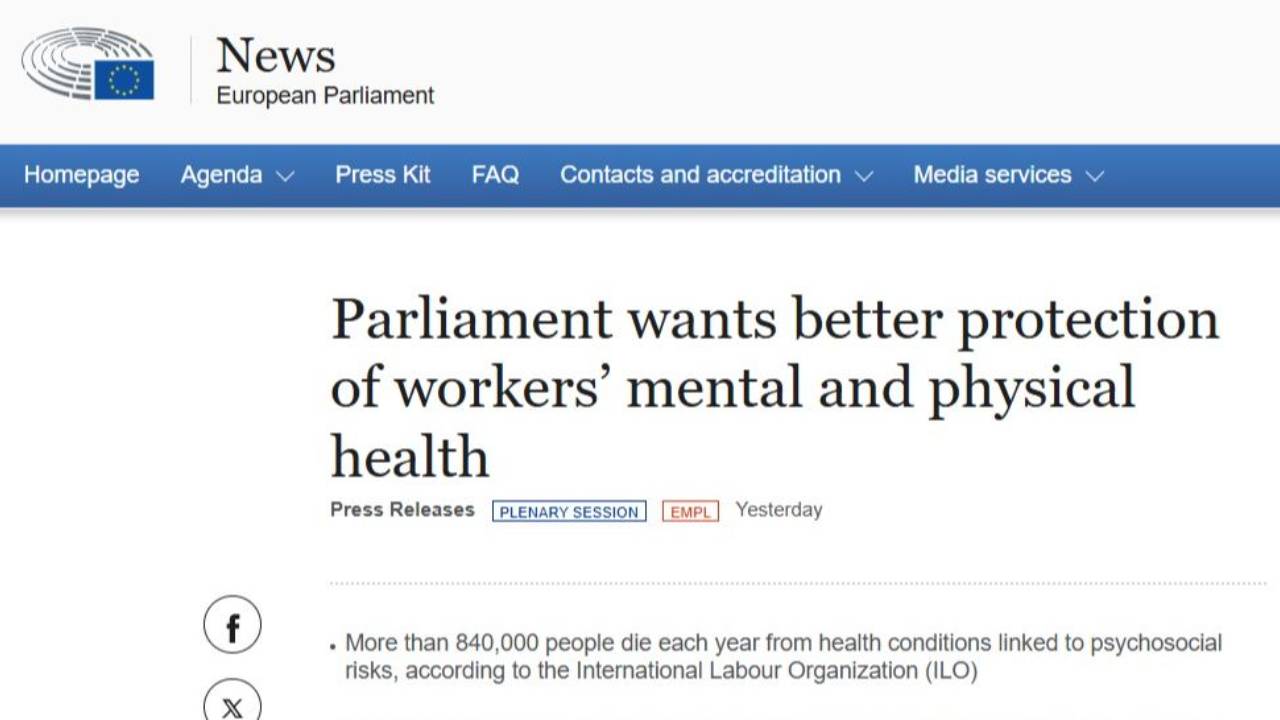
That question has become even more relevant following the European Parliament's latest call for stronger protection of workers from work-related psychosocial risks and stress.
What is the European Parliament asking for?
The European Parliament is calling on the European Commission to develop stronger measures to prevent, eliminate or reduce work-related psychosocial risks.
Its recommendations go beyond mental health support. They include regular psychosocial risk assessments and concrete action plans, attention to excessive workload and work intensity, measures addressing violence, harassment, bullying and discrimination, and sustainable return-to-work plans.
Parliament also wants psychosocial risk to be considered before significant restructuring or reorganisation, including changes involving telework, automated decision-making and monitoring systems. PubAffairs Bruxelles
An important distinction: this is not yet a new EU law imposing these requirements on employers. Parliament has adopted a legislative initiative report and the European Commission now has three months to respond to its request. PubAffairs Bruxelles
But the direction of travel deserves attention. Because the conversation is moving beyond supporting mental health towards how organisations identify and manage the conditions of work that may create psychosocial risk. And that is a very different organisational challenge.
Why might another risk assessment not be enough?
Imagine that your next psychosocial risk assessment identifies excessive workload. What happens then?
-
HR sees increasing absence.
-
HSE identifies workload as a psychosocial hazard.
-
Wellbeing sees employees asking for support.
-
Managers are under pressure to deliver.
-
Senior leadership sees targets that still need to be achieved.
Who connects those different perspectives?
And more importantly:
Who has the authority to change the conditions creating the risk?
This is where I believe organisations need to challenge themselves.
-
You can have a risk assessment and still lack ownership.
-
You can have data and still lack insight.
-
You can have a reporting channel and still lack the independence or authority to act.
-
You can support an employee and leave the underlying work conditions unchanged.
-
And you can have excellent initiatives in HR, HSE and Wellbeing while each function sees only one part of the picture.
More activity does not automatically create more organisational capability.
So what does organisational capability mean in practice?
For me, psychosocial risk management becomes meaningful when an organisation can move from: signal → understanding → decision → action → learning.
That requires more than one department.
-
It requires Leadership & Accountability to establish who owns the risk and who is accountable for acting.
-
It requires Governance & Systems so that responsibility is supported by sufficient mandate, independence and authority.
-
It requires Organisational Signals to bring together what employees, HR, HSE, Wellbeing, managers and other parts of the organisation are seeing.
-
It requires Measurement & Insight to distinguish isolated information from patterns and understand what may be happening underneath the numbers.
-
And it requires Learning & Adaptation so that identifying a problem eventually changes something about how work is designed, led or managed.
This is the thinking behind The Organisational Capability Framework™.
Not another wellbeing initiative. A way of connecting the capabilities an organisation already needs in order to make psychological safety and psychosocial risk management part of how the organisation actually works.
Why does this matter now?
The European Parliament's recommendations make one thing particularly interesting. They repeatedly connect psychosocial risk to work itself: workload, work intensity, restructuring, work organisation, digitalisation and algorithmic management. PubAffairs Bruxelles That changes where the conversation belongs.
-
Psychosocial risk cannot sit with Wellbeing alone.
-
It cannot sit with HR alone.
-
And it cannot sit with HSE alone.
Because if the source of risk sits in the way work is designed, targets are set, change is managed, technology is introduced or leadership decisions are made, then prevention requires the ability to influence those parts of the organisation too. The risk may be psychosocial. The response has to be organisational.
That, for me, is the bigger question behind the European development.
Is your organisation ready?
Perhaps readiness should not be measured by how many wellbeing initiatives you already have. A more revealing test might be:
If a serious psychosocial risk emerged tomorrow, could your organisation connect the signals, understand what is driving the risk, establish who is accountable, make the necessary decisions and change the conditions contributing to it?
If the answer is unclear, the gap may not be another initiative. It may be organisational capability. And this is exactly the conversation I want to continue.
I am looking to connect with HR, HSE, Prevention, Wellbeing, Risk, Governance and other professional partners who are exploring how psychological safety and psychosocial risk can become more deeply integrated into organisational practice.
Not because one discipline has the complete answer. But because the challenge crosses the boundaries between them.
If your work touches this same question, I would be very interested to exchange perspectives and explore where our expertise could strengthen each other. I would be very happy to hear from you.
Get in touch and let’s explore what we might build, strengthen or learn together.
