Why does psychosocial risk fall between HR, safety and leadership?
Annick Rogiers · Founder, Sustainable Wellbeing Solutions — I help HR, HSE and prevention leaders prove how they manage psychosocial risk, not just describe it.
Five questions that reveal whether psychosocial risk is truly being managed
Organisations are getting better at responding when difficult incidents occur. Managers have more language, policies are clearer, and support is often available. Yet six months later, one question remains surprisingly difficult to answer:
What actually changed?
A concern may have been investigated. A leader may have received coaching. A policy may have been reviewed. Training may have been delivered. Everything appears to have been addressed.
And yet the way work is designed, allocated or led may remain exactly the same.
That is not a failure of effort. It is a failure of structure.
Psychosocial risk often sits between HR, Health and Safety, wellbeing and leadership. Each function holds part of the picture. But when no one connects those parts, responsibility becomes diffuse. This is particularly difficult when the person with authority to act is also part of the concern.
The following five questions help organisations test whether they are genuinely managing psychosocial risk - or simply documenting activity.
-
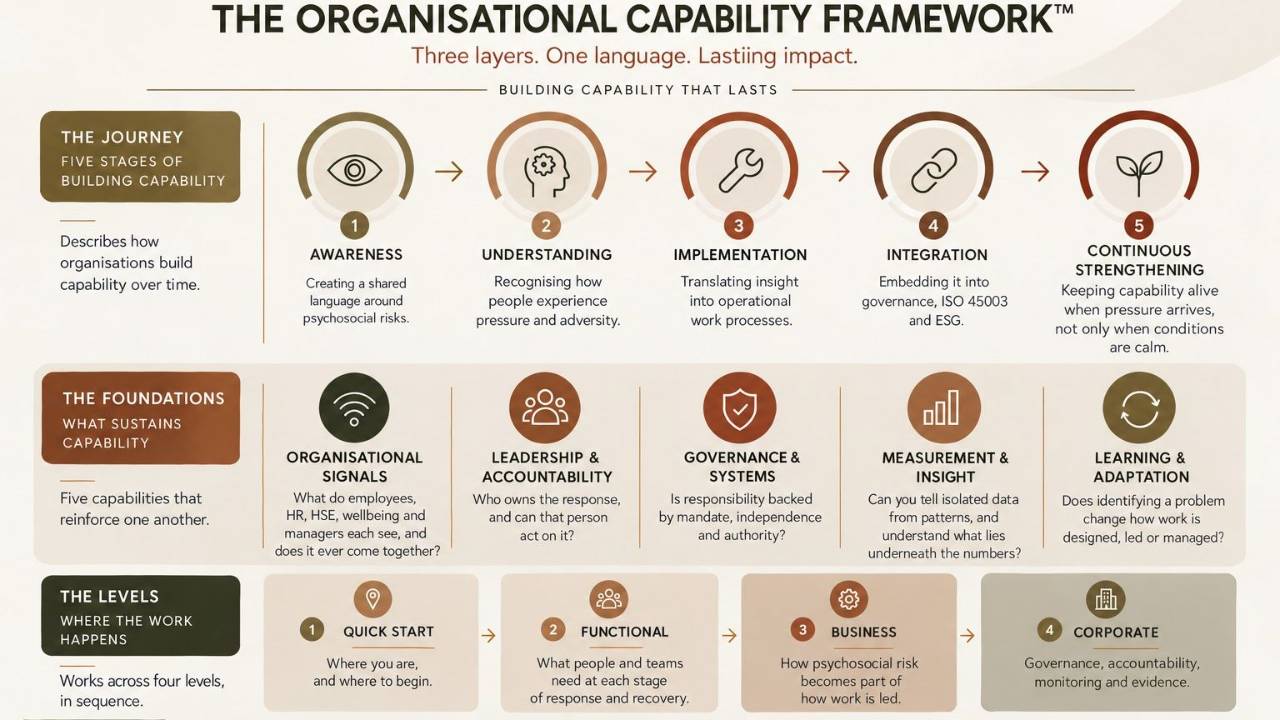
Where did the signal come from?
Can you name one psychosocial risk assessed in the past twelve months and explain where the signal originated?
The signal might have come from an employee survey, rising absence, repeated concerns, overtime data, an incident, exit interviews or changes in behaviour.
A single signal is not a diagnosis. However, when HR, HSE, operations and leadership each hold related information, the organisation needs the capability to connect it. If nobody can explain where a risk first became visible, it becomes harder to understand whether the organisation responded early or only after harm became obvious.
-
Who owns the response?
Can you name the person accountable for the control that followed?
A name, not a department.
"HR", "the safety team" or "leadership" may describe where responsibility is discussed, but they do not identify who remains accountable for action. When responsibility is distributed across several functions without one named owner, everyone may contribute while no one is ultimately answerable for the outcome.
Clear ownership does not mean one person does everything. It means one person ensures that the response moves from discussion to decision, action and review.
-
Does ownership come with authority?
Does the named owner have the mandate to change work design, staffing, schedules, priorities or reporting lines?
Accountability without authority exists only on paper.
This becomes especially important when the risk is linked to workload, time pressure, staffing levels, organisational change or leadership behaviour. HR may recognise the problem but lack authority over operational targets. Safety may document the hazard but be unable to change staffing. A manager may want to intervene but need approval from the same hierarchy implicated in the concern.
The organisation must therefore ask whether its escalation routes are genuinely independent and whether the person receiving the signal can influence the conditions creating the risk.
- Can you demonstrate what changed?
Can you show what changed because of the response - in work design, not only in a survey score?
Organisations often measure activity: the number of managers trained, policies reviewed, actions entered into a register or employees referred for support.
Those measures confirm that something was done. They do not prove that the risk is better controlled.
If excessive workload was identified, did staffing, priorities or task allocation change? If role ambiguity contributed to the risk, are responsibilities now clearer? If employees were afraid to speak up, what happens differently when they raise a concern?
The relevant question is not: what did we do?
It is: what is different because we did it?
- What did the organisation learn?
Has any concern raised in the past two years changed how work is designed, allocated or led?
A closed case is not the same as a changed system.
Organisations often investigate an incident, address the immediate issue and move on. Meaningful learning goes further. It asks whether the event exposed assumptions, incentives or structures that made the problem possible.
That learning should influence future decisions. Otherwise, the same pattern may return in another team, under another leader and with another name.
The test of learning is not the quality of the investigation. It is whether the next situation is handled differently.
What do your answers reveal?
These five areas are rarely equally strong. An organisation may have good reporting channels but weak accountability. It may have a named owner without sufficient authority. It may collect extensive data but be unable to show what changed.
If two or more answers are "no" or "not sure", the organisation may have the structure without the evidence.
That is the gap an inspection is likely to expose. It is not a gap in care or commitment. It is the structural gap between identifying a risk and proving that it is being controlled.
The real question is therefore not whether an organisation has policies, reporting channels or wellbeing initiatives.
It is whether it can follow the complete trail:
Signal → insight → decision → action → evidence → learning.
When that trail is visible, psychosocial risk management becomes more than an intention. It becomes an organisational capability that can be demonstrated - especially when pressure tests it.
Where does your organisation stand?
A strategy conversation identifies your level and what the Quick Start would look at first.
