Quick Start: where are you, and where do you begin?
Annick Rogiers Founder, Sustainable Wellbeing Solutions - Connecting Psychological Safety, Psychosocial Risk and Organisational Practice
Quick Start: where are you, and where do you begin?
Most organisations don't begin work on psychosocial risk from a place of clarity. They begin when something feels off — pressure is rising, tensions are harder to ignore, or an incident has disrupted what once felt manageable.
That is the moment Quick Start is built for.
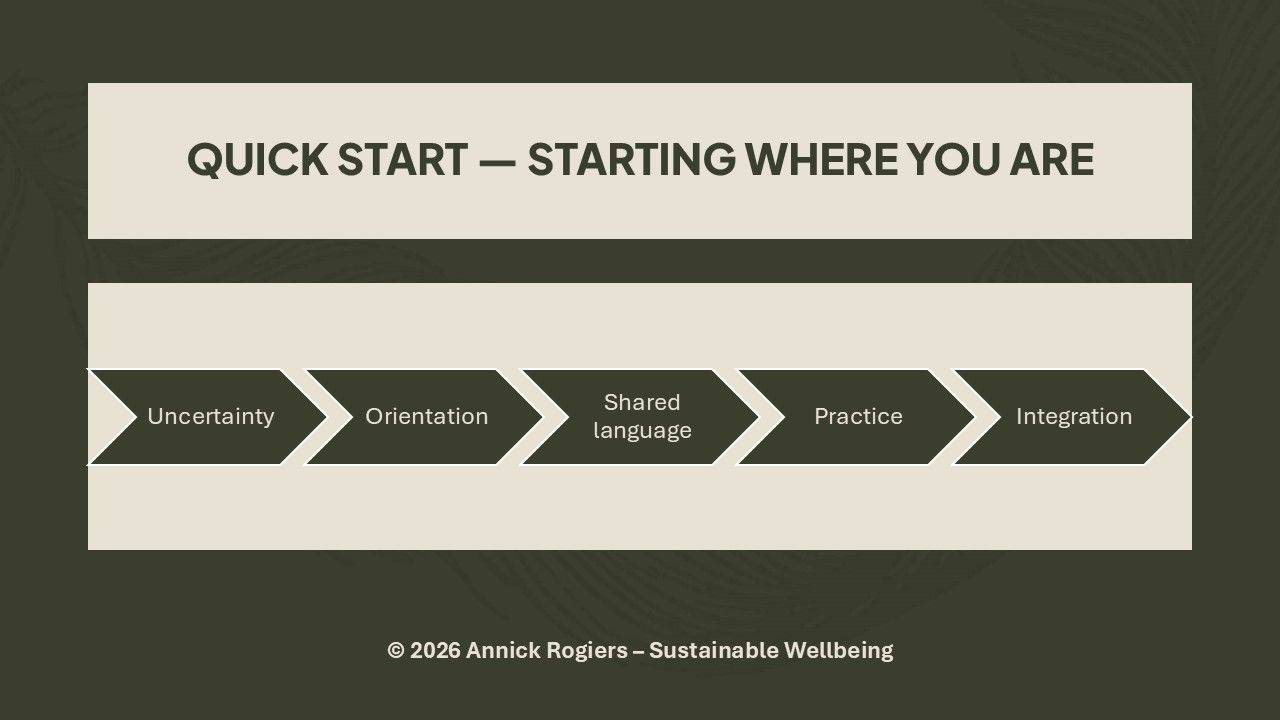
Uncertainty is a legitimate starting point
Uncertainty is not a weakness or a lack of professionalism. It is a signal that complexity has entered the system.
When organisations move too quickly past this moment, responses tend to become fragmented: individualising what is systemic, or introducing measures that don't hold over time. Acting fast can feel reassuring. It rarely creates sustainable change.
So the first move is not action. It is noticing.
Orientation: what psychological safety actually is
Orientation is not about resolving uncertainty. It is about gaining direction.
Here, psychological safety does two things at once: it becomes both a guiding principle and a concrete objective. In practice, it refers to a shared belief that people can raise concerns, questions and mistakes without fear of humiliation or negative consequences.
This belief does not remove responsibility. It enables it — by making it possible to speak when something is not right.
One misunderstanding is worth naming. Psychological safety does not mean avoiding discomfort or difficult conversations. The opposite is true: it makes difficult conversations possible, because people trust that raising a concern won't be punished or dismissed.
It supports speaking up rather than staying silent. It enables learning rather than perfection. It does not mean agreement, unlimited disclosure, or the absence of accountability.
When psychological safety is confused with comfort, organisations avoid tension — and allow risk to grow beneath the surface.
At this stage it works as an orientation tool. It helps an organisation ask:
- What is currently safe to say — and what is not?
- Who feels able to raise concerns, and who hesitates?
- How do leaders respond when something uncomfortable is named?
These questions are not about judging culture or performance. They are about understanding conditions. Without that understanding, attempts to address psychosocial risk remain reactive.
Shared language: turning experience into something others can work with
Many of the risks people encounter are linked to psychosocial hazards: conditions in the design, organisation or management of work that, when frequent, prolonged or intense, contribute to strain, stress, fatigue or anxiety.
Shared language makes it possible to talk about those risks collectively, rather than leaving them as individual impressions.
Without it, signals fragment. Similar experiences get described in different ways, patterns stay hidden, and responses become disconnected. Early warning signals are missed — not because they are absent, but because they cannot yet be named together.
Shared language is not technical jargon. It means people use similar words for similar experiences, recognise recurring patterns, and describe risk factors consistently in conversations, meetings and reports. That vocabulary makes it possible to notice emerging risk before it escalates, discuss concerns in ways that feel less personal, and develop responses that are aligned across roles.
Shared language is not about saying everything. It is about saying enough, together, to make risk visible and discussable.
First practice: how an organisation communicates in the first moments
A difficult incident, a sudden loss, escalating conflict or cumulative pressure doesn't only trigger decisions. It triggers communication. What is said, how it is said, and what is left unsaid in those early moments shapes how people interpret the situation and how safe they feel.
At this stage, practice does not mean procedures or policies. It means containment:
- Pause — interrupts automatic reactions and creates a moment of choice
- Acknowledge — recognises that something happened and had impact, without interpretation
- Contain — sets temporary boundaries: what is known and not known, what can be addressed now or later
- Connect to next steps — prepares for structured follow-up without rushing into it
This flow does not replace procedures. It precedes them.
Being trauma-aware at this stage does not mean analysing trauma or asking people to share personal experiences. It means recognising that people react differently to the same situation, that cognitive processing is reduced under stress, and that premature problem-solving increases distress. It helps leaders act with care while staying within their role.
Integration: shared holding, not implementation
After uncertainty, orientation, shared language and first practice, something has already changed. Not a system — but a way of holding complexity with care and responsibility.
At this stage, integration means shared holding. Knowing who carries which responsibility for now, recognising what can be acted on today, and understanding what requires structure later — without forcing clarity where it doesn't yet exist.
One of the greatest risks in this work is carrying responsibility alone. Integration distributes it realistically.
It also brings clarity about involvement. HR, HSE and prevention professionals usually hold the first line of orientation and coordination. Leaders shape psychological safety through their responses, decisions and presence. Governance and policy become relevant later — once there is clarity about patterns, risks and practice.
Not everyone needs to be involved at once.
And a common concern at this point: is action legitimate without a formal policy? Responsible action does not come from documents yet. It comes from principles — acknowledging impact, using shared language, respecting role boundaries, avoiding premature solutions. Those principles prevent paralysis without encouraging impulsive action.
Why the order isn't optional
The Framework works across four levels — Quick Start, Functional, Business and Corporate — and each builds on the last.
Quick Start is not a smaller version of the rest. It is the level where an organisation moves from uncertainty to shared responsibility. Skip it, or start with implementation because it feels more decisive, and every step after rests on assumptions nobody has tested.
Structured integration — formal policies, frameworks, governance — becomes legitimate once there is shared understanding and shared responsibility to build on. That is the progression this level creates.
Continue with: Functional Level — A New Lens for HR, HSE and Wellbeing Professionals →
