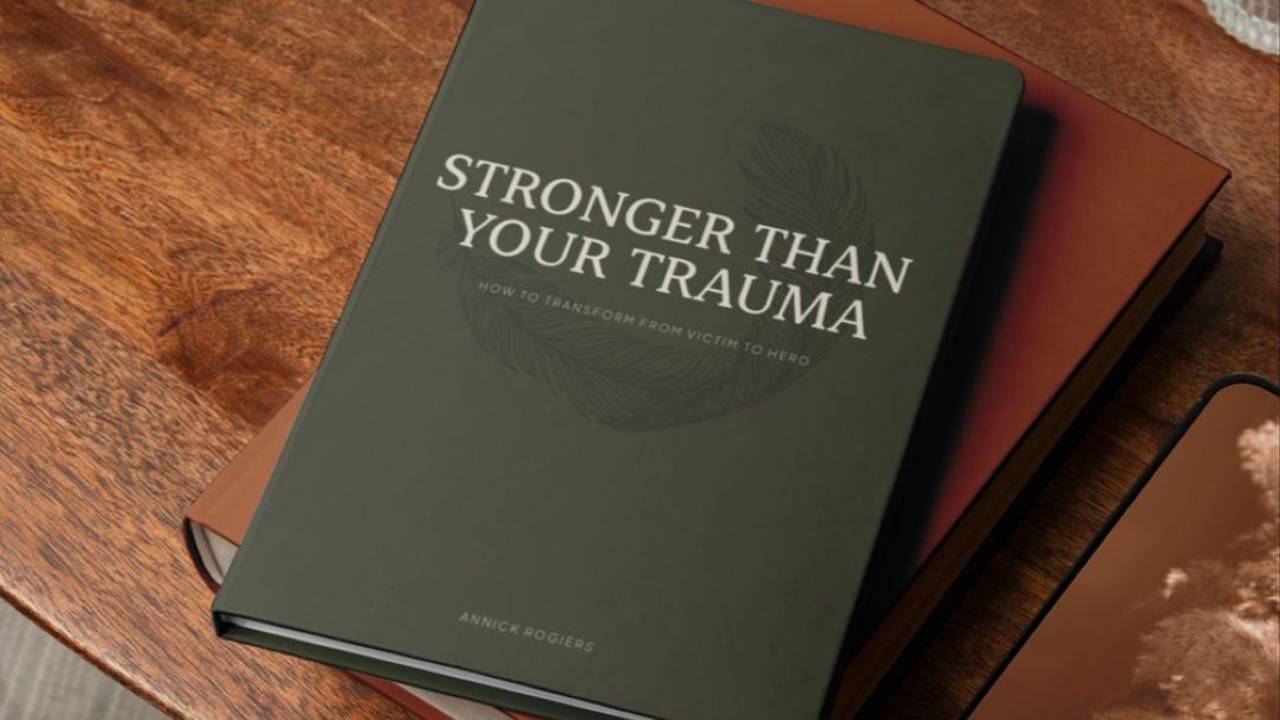
Wellbeing & Recovery: Why I wrote 'Stronger Than Your Trauma – How to transform from victim to hero'
Annick Rogiers Founder, Sustainable Wellbeing Solutions - Connecting Psychological Safety, Psychosocial Risk and Organisational Practice
Why I wrote 'Stronger Than Your Trauma'
Two traumatic events shaped this book. First an armed robbery. Later, losing my partner in a road traffic accident.
And then, in my HR role, watching how often people were left alone after such events. Not because others didn't care — but because they didn't know how to respond. There was no language. No guidance. No real support.
The book is not a solution. It is a companion — for anyone trying to understand the aftermath of a life-altering, one-time traumatic event.
When does an event become trauma?
Trauma can arise when a one-time event — an accident, violence, sudden loss — divides a life into a before and an after.
In an instant, your sense of safety can disappear. Your world no longer feels predictable. What remains is often confusion, fear… and silence.
That silence is why it so often goes unnoticed. The impact is largely invisible to those around you. People keep functioning on the outside while struggling on the inside with something there seems to be no language for. That hidden reality is what this book is about.
Where experience met professional insight
I have lived through trauma myself, and I have spent more than 35 years in HR, leadership and organisational development. I am an ICF-certified coach, an author and an international keynote speaker, founder of Sustainable Wellbeing Solutions, and developer of The Organisational Capability Framework™.
That dual perspective is the only reason this book exists. I have been on both sides: the person it happened to, and the professional expected to respond.
One question connects the two — how can you support someone through trauma if you don't understand what it feels like? That question became the starting point of this book.
Why this book exists
I didn't write it because I had all the answers. I wrote it because I remember what it felt like not to have any.
When trauma hits, you are left with pain, questions and a deep sense of disconnection. From others. From yourself. From life. There is often no guide. No gentle voice. No clear way forward.
This book is not a solution. It is a companion.
A quiet reminder:
- that what you are experiencing deserves understanding
- that you don't have to make sense of everything at once
- that growth after trauma may be possible
Who is this book for?
For anyone facing the aftermath of a life-altering, one-time traumatic event.
Not to "fix" what happened — but to begin understanding what comes next. This book promises no linear recovery and no fixed route. It offers recognition: a starting point, not an endpoint.
What model forms the foundation of the book?
The book is built on the five-phase model of post-traumatic growth developed by clinical psychologist Dr. Edith Shiro. The model offers no quick answers — but structure, recognition and a gentle sense of direction.
In The 5 Phases of Post-Traumatic Growth: A Personal Perspective, I explore how these phases can offer recognition after trauma, without suggesting that recovery follows a fixed or linear path.
Where confusion dominates, structure helps. These phases are not steps to tick off, but experiences to gradually recognise within yourself as your healing unfolds.
A first step forward
If you recognise yourself in these words, you don't have to understand everything at once — and you don't have to do it alone.
Read the book Stronger Than Your Trauma: How to Transform from Victim to Hero — recognition, structure and a gentle sense of direction after trauma.
Then step into the platform The Sustainable Wellbeing Platform after Trauma is a supportive place to stay connected, gain perspective and keep moving forward — practical resources, an online community, monthly live Q&A and guided reflection, for anyone navigating the lasting or traumatic impact of difficult experiences.
Or begin with a conversation Not sure where you fit? I offer a complimentary 20-minute introductory call — a confidential, no-obligation space to explore what you're experiencing and which form of support best fits your needs.
If your organisation recognises this and wants to act on it, there are one way I work with organisations:
Keynote — a shared language around psychological safety, psychosocial risk and organisational responsibility, in one session.
Book your free 20-minute conversation →
Also read: The 5 Phases of Post-Traumatic Growth: A Personal Perspective →
"Life can be understood backwards but must be lived forwards." — Søren Kierkegaard
