Is Your Organisation Structurally Ready to Begin?
Before entering the 4-Module Programme, assess whether the foundational conditions for sustainable psycosocial governance are in place.
Download the Governance Readiness Self-Assessment — a structured reflection designed to clarify your starting position.
Download the Free AssessmentWhy This Assessment Matters
Many organisations introduce structured learning before governance alignment is secured.
Under sustained pressure, signals surface — but without clear ownership, integration or sequencing, even well-designed initiatives struggle to create lasting impact.
Psychosocial governance maturity does not begin with training.
It begins with clarity.
This assessment ensures that entry into the programme strengthens governance architecture rather than adding parallel activity.
The 5-Phase Readiness Framework
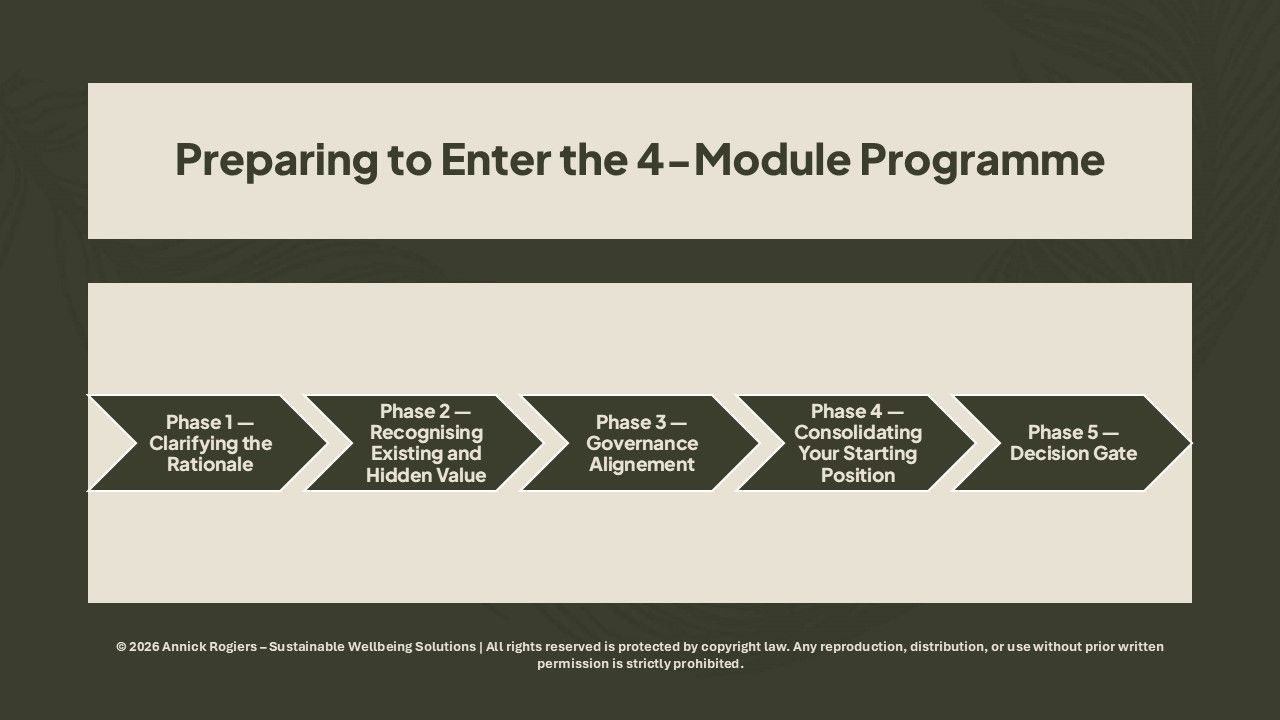
This structured reflection guides you through five deliberate phases:
-
Clarifying your organisational rationale
-
Recognising existing strengths and structures
-
Securing governance alignment and ownership
-
Consolidating your starting position
-
Confirming readiness for structured activation
Together, these phases provide a stabilising sequence — protecting legitimacy, continuity and coherence before implementation begins.
What You Will Clarify
Upon completing the assessment, your organisation will have greater clarity on:
• Why structured psychosocial governance is being introduced
• What governance strengths can be built upon
• Where structural gaps may exist
• Whether ownership and sponsorship are sufficiently defined
• Whether the organisation is ready to proceed
This is not a diagnostic of failure.
It is a governance readiness instrument.
Who This Is For
This assessment is intended for:
• HR and HSE leaders
• Prevention and wellbeing professionals
• Managers and executives responsible for safeguarding people under pressure
• Governance and risk professionals seeking structured integration
If your role involves translating care for people into sustainable governance practice, this reflection provides a disciplined starting point.