Why Good Wellbeing Initiatives Sometimes Fail
Annick Rogiers Founder, Sustainable Wellbeing Solutions - Connecting Psychological Safety, Psychosocial Risk and Organisational Practice
Why Aren't Wellbeing Initiatives Creating Lasting Change?
Because the problem is rarely a lack of commitment. It's a lack of integration.
Many organisations have invested significantly in wellbeing programmes, psychosocial risk management and psychological safety. Yet a common frustration remains. Employees still experience inconsistent support. Managers still feel uncertain about how to respond to difficult situations. Organisations still struggle with psychosocial risks and critical incidents.
For years, organisations have approached these challenges through separate initiatives. HR develops wellbeing strategies. HSE manages psychosocial risks. Leadership programmes focus on culture. Governance teams consider ESG and organisational accountability.
Each initiative has value. Yet employees experience the organisation as a whole — they do not separate HR from HSE, or governance from operations.
Why does fragmentation show up when pressure arrives?
Because responsibility is spread across functions, and nobody owns what they create together.
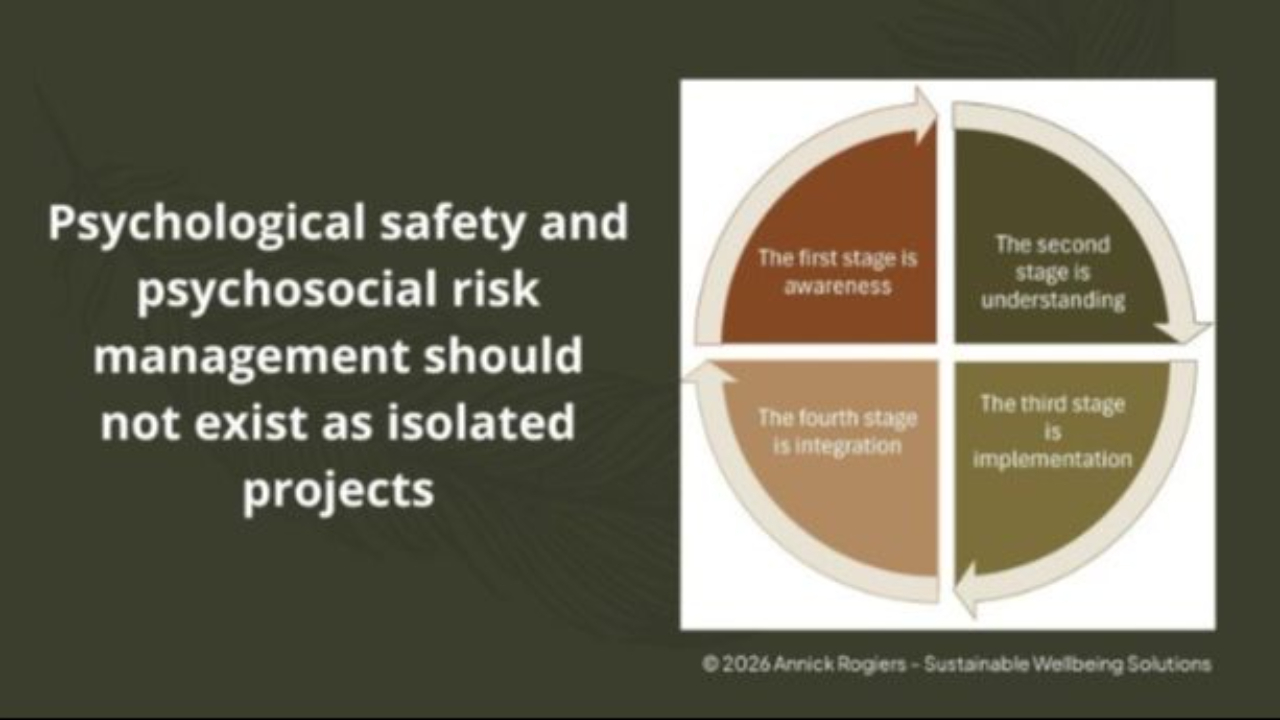
Psychological safety and psychosocial risk management should not exist as isolated projects. They should become part of the way organisations work. In my experience, organisations typically move through four stages of development.
Awareness — Understanding the realities people face under pressure, and creating a shared language around psychosocial risks.
Understanding — Recognising how adversity and difficult experiences influence individuals, teams and organisational functioning.
Implementation — Translating these insights into practical HR, HSE and operational work processes.
Integration — Embedding these principles into governance, ISO 45003 implementation and ESG responsibilities.
Each stage builds on the previous one. Skipping stages often creates fragmented initiatives and inconsistent outcomes.
What changes when psychological safety becomes organisational capability?
Managers gain confidence. Employees gain consistency. HR and HSE start working together.
-
Managers have greater confidence in responding to difficult situations
-
Employees experience greater consistency and trust
-
HR and HSE work more closely together
-
Organisational learning improves
-
Governance and ESG commitments become more meaningful
